• Skip to primary navigation
  • Skip to main content
  • Skip to footer
Green Biz PC

Green Biz PC

Park City, Utah

  • Home
  • About
    • How it Works
    • Certification Levels
  • Find a Green Business
  • Community
    • News
    • Upcoming Events
  • Log in
  • Sign up

Event Recap

Driving Change: Highlights from the Sustainable Transportation Lunch & Learn

February 12, 2026 by Celia Peterson

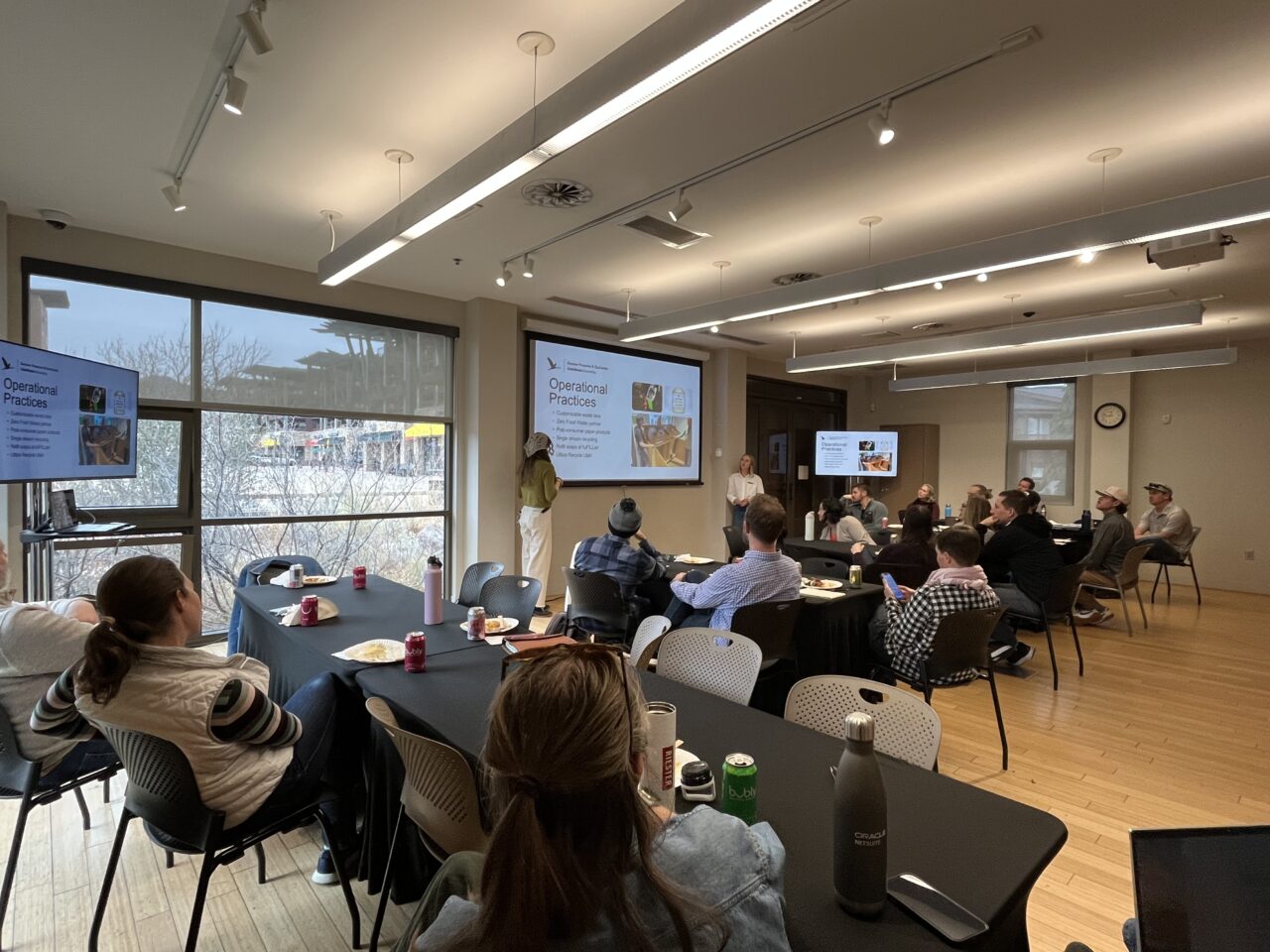
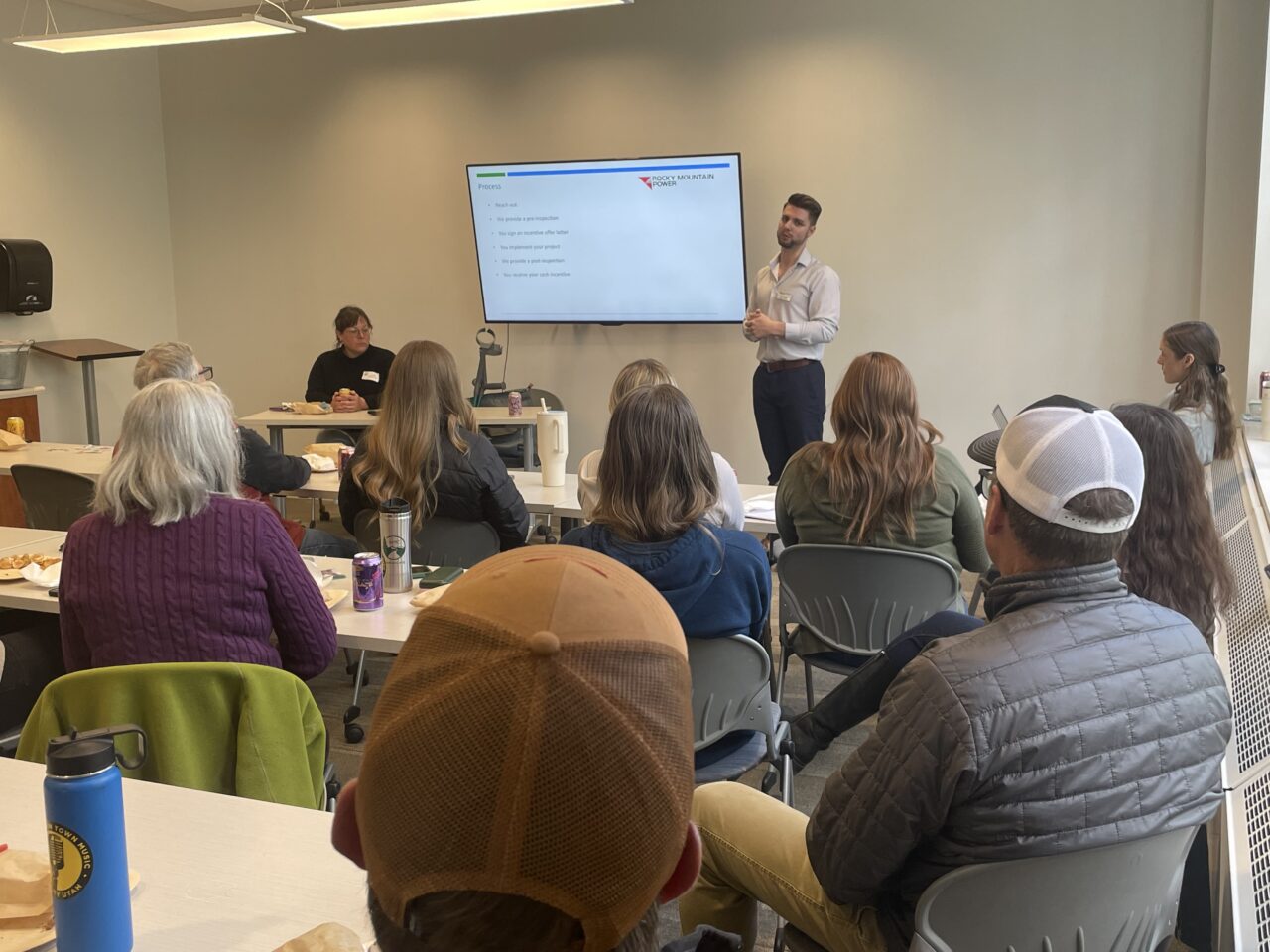
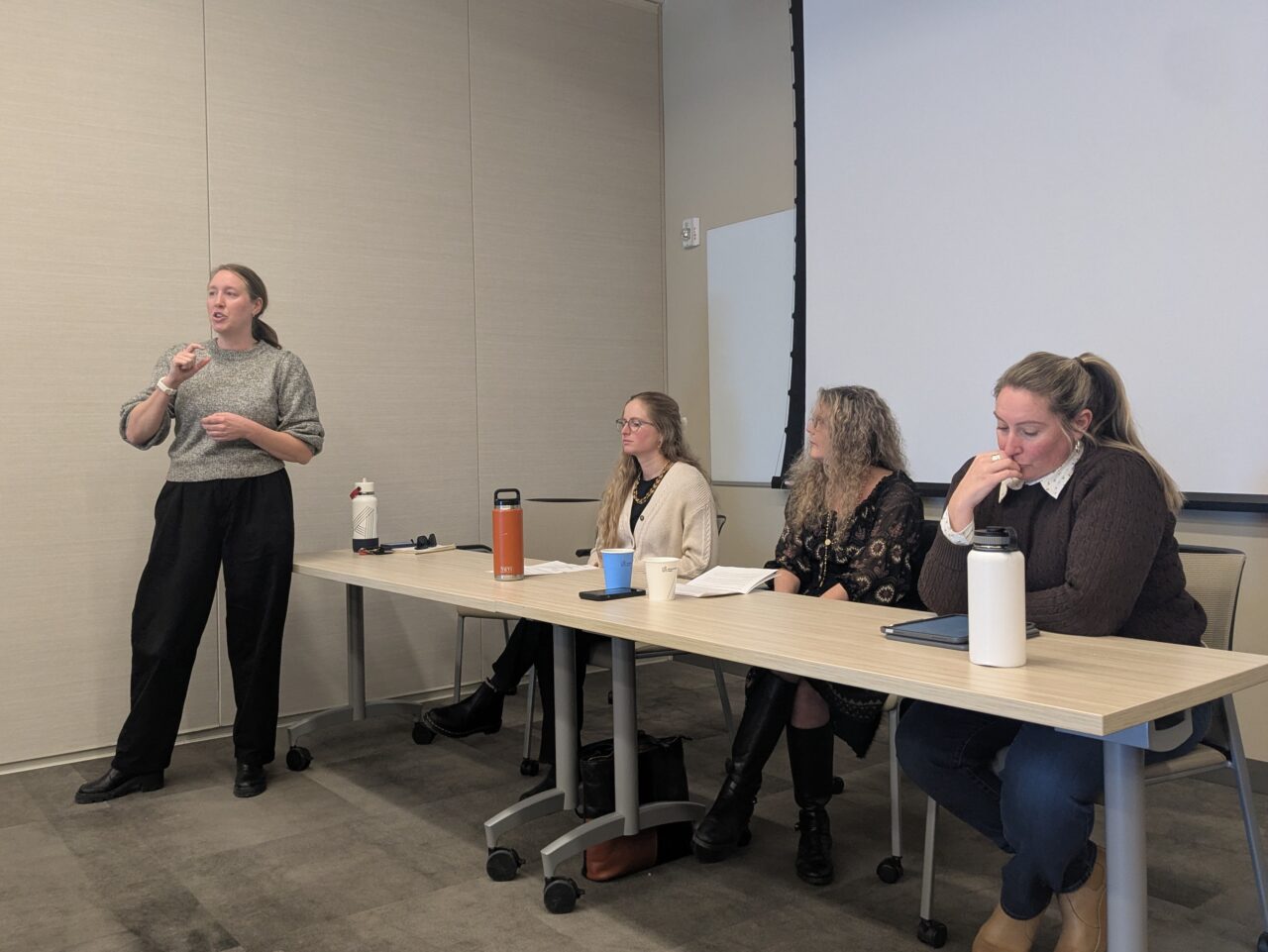
On February 11, 2026, local employees and business leaders gathered at the Park City Library for Driving Change: Sustainable Transportation in Action, to hear real-world examples of electric vehicle adoption and car-free commuting. Speakers shared practical insights on fleet electrification, operational planning, and local options to support a car-free workforce that can be implemented today.

Why Electrify Fleets?

Kelbe Goupil of Utah Clean Energy opened by highlighting the outsized pollution impact of heavy-duty vehicles. Though they account for only about 7.5% of vehicle miles traveled in Utah, they produce roughly 30% of transportation pollution and nearly half of vehicle NOx emissions. Electrifying fleets can significantly reduce these impacts while also lowering fuel and maintenance costs and giving businesses access to incentives and rebates.

Her key message: start with data. Analyzing vehicle routes, mileage, and usage helps organizations determine which vehicles are best suited for electrification, how to size fleets efficiently, and what charging infrastructure is needed. She also highlighted a free, bi-monthly Electrified Fleets Community of Practice, where fleet managers can learn from peers and experts.

Summit County reinforced this point by sharing results from a recent fleet analysis showing many organizations operate more vehicles than necessary. Simply right-sizing fleets before electrifying can produce immediate cost savings and emissions reductions.

Real-World Lessons from Fetch Park City

Tony Saylor, owner of Fetch Park City, shared a candid account of transitioning his dog-transport fleet to electric vans. His company operates daily routes of about 100 miles with frequent stops and steep terrain — conditions well suited for EVs.

After a year, he reported:

  • About $18,000 in annual fuel savings
  • Reduced routine maintenance
  • Reliable performance for multi-stop routes
  • Quieter rides appreciated by drivers and dogs alike

Challenges included higher upfront costs, charger installation expenses, and initially limited local maintenance options. His biggest pro-tip for businesses: start with one vehicle first to manage the learning curve before scaling up.

Vanpooling: Another Path to Lower Emissions

Transportation planners highlighted the regional Vanpool Pilot Program, which helps employers reduce local traffic and commuting emissions. Summit County and Park City currently subsidize up to 50% of vanpool costs, and businesses can share vans with nearby employers if they have at least four riders. A Guaranteed Ride Home program in Park City provides backup transportation in emergencies, removing a major barrier for participants.

Key Takeaways for Businesses

Across presentations, several themes stood out:

  • Use real fleet data to guide decisions.
  • Plan charging infrastructure early. Overnight charging is most cost effective.
  • Evaluate total cost of ownership, not just purchase price.
  • Partner with regional programs and peer networks.

Many of these actions — such as adopting an electric-first purchasing policy or supporting alternative commuting — can also earn points toward Green Business Certification.

The next Green Business Lunch & Learn will take place in May and focus on Thriving Community & Equity. Let us know if you are interested in a particular topic!

Filed Under: Event Recap

Lunch and Learn Recap – Sustainable Purchasing in Action

November 17, 2025 by Megan

What is sustainable procurement and why does it matter? 

It is estimated that purchasing accounts for more than 50% of a business’s carbon emissions, from the energy and resources required to make, transport, and dispose of products. Understanding the purchasing power of your business is essential to reducing your organization’s impact and driving meaningful sustainable change.

The November Lunch and Learn explored this topic and highlighted how businesses can take a more active approach to purchasing.

We were joined by Windy Aphayrath, Chief Procurement Officer for the State of Utah, and Michelle Brown, Coordinator for Resource Stewardship for the Utah Department of Government Operations, who discussed sustainable procurement practices. The Swaner EcoCenter team also shared how they approach sustainability when selecting products for their gift shop.

Key takeaways from Windy and Michelle for businesses looking to improve the sustainability of their purchasing strategies include:

  • Evaluate metrics and data you already have access to: Platforms such as Amazon now offer sustainability-related insights on your orders to help you better understand the environmental impact of what you buy. Under Amazon’s Programs & Features, you can also search for Climate Pledge Friendly products (look for the green leaf symbol indicating product sustainability features)
  • Use third-party certifications to guide purchasing decisions: To avoid greenwashing, rely on reputable third-party certifications that align with your sustainability goals. For greater assurance, look for multi-attribute certifications. Learn more about third-party certifications here
  • Ask for help: Whether internally across divisions or within the community, seek partners who can support your sustainable procurement journey through knowledge sharing and resources. The Green Business Team is also available to help!

Consider these guiding questions used by the Swaner EcoCenter to select vendors and products for their gift shop: 

  • What vendors and products are available locally?
  • What products promote sustainable behavior (e.g., rechargeable batteries, reusable bags)?
  • Is there a product that can educate customers about nature, community, or sustainability topics relevant to your industry?

Here are some ways you can challenge your staff to put these tips into practice:

  • After reviewing your purchasing history, you discover that you currently purchase 5 products from local vendors. Can your business set a goal to double that within a year?
  • In speaking with your staff, you learn that paper products are the most commonly purchased item in the office. Can your business set a goal to phase in 30%, then 100% recycled-content paper products?
  • When cleaning up after every board meeting, you notice that there are always plastic water bottles left to recycle. Can your staff pilot water pitchers and reusable cups for next time?

Check out the event slides for more information on the topics covered.

Stay tuned for more information on our February Lunch and Learn! 

Filed Under: Event Recap

Lunch and Learn Recap — Know Your Flow (8/13/25)

August 15, 2025 by Celia Peterson

In the heat of the summer, our August Lunch and Learn focused on one of our community’s most pressing topics- water! The Park City Water Department hosted us at the Three Kings Water Treatment Facility where we discussed the importance of water management, leak detection, landscape incentives, and more! 

Key topics covered by our presenters, Jason Christensen, Susan Cordone and Christine Williams from the Park City Water Department included: 

  • Park City’s water rates are structured to incentivize water conservation — the more a customer uses, the more expensive the charge 
  • Commercial customers of Park City have the ability to choose their base rate — businesses should ensure their current base rate is optimal for their operations
  • Water use in a mountainous community requires lots of pumping which is energy intensive, meaning when you conserve water, you contribute to conserving energy too 
  • Stormwater flows directly into creeks in our community which is why we should always prevent pollutants entering stormwater drains and educate our staff on stormwater best practices

Important takeaways

  • Identify who receives the water bill for your business and start a conversation about tracking cost and consumption — you would be surprised at how quickly you can start noticing overusage with basic tracking
  • If your water provider has an online platform to track usage — Park City, Mountain Regional, and Summit Water all do — determine which two people at your business should have access to this portal to enhance day-to-day water management 
  • Take advantage of landscape incentive programs offered by the state or your water provider to replace turf with water efficient landscaping 
  • Minimize stormwater pollution by reducing salt use in the winter, removing turf to reduce pesticide use, and bringing fluorinated ski wax to Recycle Utah

Resources

  • Landscape incentive programs: Park City , Mountain Regional, and Utah Water Savers 
  • Visit the Conservation Garden Park in South Jordan to get ideas on waterwise landscaping 
  • Sign up for a free tour of the Three Kings Water Treatment Plant here to learn more about the sustainability elements of their building and operations 

Filed Under: Event Recap

Lunch and Learn Recap – Watt’s the Cost?

May 19, 2025 by Megan

Our May Lunch and Learn focused on energy management and energy efficiency strategies for businesses to reduce usage and save on utility bills. We heard from Evan Heil and Kate Whitbeck from kW Engineering, a partner of Rocky Mountain Power’s WattSmart program, and from Ben Liegert and Allan Hilton with Basin Recreation’s Facilities team. Read below for some key takeaways and lessons learned from kW Engineering, Basin Recreation, and the MARC.

Key takeaways:

kW has free energy management services to offer Park City and Summit County businesses and can advise on efficiency upgrades, including available utility incentives.

  • kW Engineering is here to help: At no-cost and with cash incentives available, kW can help businesses improve their building’s energy efficiency through multiple pathways including energy benchmarking, improvements to building system controls, and upgrades to building envelopes, HVAC systems, and lighting.  
  • Understanding your utility bill: The “Demand Charge” on your Rocky Mountain Power bill is where energy management and efficiency projects will produce the most savings for your business. This charge represents the highest amount of energy used in 15-minute intervals during a billing cycle. By focusing on reducing your building’s greatest energy loads, you can achieve monthly savings while also helping to extend the life of building equipment. 
  • How to get started with energy benchmarking and management: Start tracking your building’s energy use using your monthly utility bills. You can do this through Energy Star’s Portfolio Manager or by starting a simple spreadsheet that looks at monthly electricity and gas usage over the last few years. Need help? Reach out to Celia Peterson or Megan Nick to get started. 

Basin Recreation continues to see the benefits of energy efficiency improvements at the Fieldhouse. 

  • The facilities team at Basin Rec has been working on improvements to their buildings over the last 18 months. This included a no-cost building walkthrough with kW Engineering at the Fieldhouse, where multiple actions were identified to reduce energy use and improve the building control systems. 
  • Since updating their building control software system, Basin Rec has seen a consistent decline in monthly energy usage. They are also seeing energy use go down from repairing solar inverters and implementing other efficiency measures.
  • A key to Basin Rec’s success is internal support for facility improvements. By having a sustainability team made up of staff members from different departments who are passionate about driving change from within, Basin Rec continues to make sustainable improvements across their organization. 

The approach to energy efficiency at PC MARC continues to evolve through lessons learned at its facilities.

  • Keeping an eye on electricity AND natural gas usage is critical for effective energy management. During the wintertime, natural gas use is considerably higher than electricity in Park City. As a major source of emissions, and without a feasible renewable alternative (yet), natural gas must be included in energy benchmarking and efficiency measures.
  • The MARC has taken advantage of several incentives over the years, including lighting controls and fixture upgrades, installation of sensors in the basketball courts, and efficient pool pumps.
  • A focus on practicality and occupant needs is essential. While lighting sensor technology can be a nuisance in office spaces, simple solutions – like hanging a thermal blanket over a drafty door – can result in considerable savings. As a business, take the time to evaluate which efficiency upgrades will be most cost-effective for your operations. And remember, efficiency, especially related to heating spaces, is the cheapest form of energy you can use!

Stay tuned for our next Lunch and Learn in August on the topic of water! 

Filed Under: Event Recap, News

Lunch and Learn Recap – Protecting worker health and well-being

February 25, 2025 by Celia Peterson

On February 12th, the Green Business Program hosted a lunch and learn on the topic of protecting worker health and wellbeing. The discussion included strategies to engage hard-to-reach audiences and for workplaces to support employees navigating political and policy uncertainty at the federal level.

Our panel was moderated by Morgan Mingle, Director of Sustainable Tourism for the Park City Chamber of Commerce and Visitors Bureau.

Bailey Quinn, Multicultural Communication and Outreach Specialist with the Summit County Health Department shared best practices for connecting our Spanish speaking community with health resources. She showcased the Spanish Facebook page Condado de Summit and a recently launched WhatsApp group. Leveraging NextDoor neighborhood groups has been another useful tool to reach Spanish speaking or rural audiences.

Another unique way to connect with community members is by riding the bus! Summit County and Recycle Utah pooled together resources for bilingual communication in January to connect with individuals on public transit in Spanish and English.

Maria Villar, Director of Charity & Social Services with St. Mary’s Catholic Church, shared the importance of employees feeling welcomed and valued in their workplace. She showcased a booklet of available community resources, many pro bono, for community members in need, which can be provided to employees. Last year she helped over 400 families with financial housing and basic needs assessments – many of whom are members of our local workforce. The current increase in scrutiny of Latinx workers’ immigration status is already having real impacts, with many people not showing up at work or school. Maria advised against publicizing events where large numbers of Latinx community members may congregate.

Sarah Myers, VP of Operations for the Park City Chamber, reiterated that things are changing quickly with the new federal administration, and that certain rights around discrimination based on gender, sexuality and race may go away. She encouraged everyone to understand their rights and explained the difference between judicial and administrative warrants. The Chamber has prepared many workforce resources on this topic and more.

The panelists all reiterated the importance of ensuring that employees are seen and valued, which is a form of workplace wellness and the foundation for employees feeling safe and motivated at work.

Filed Under: Event Recap Tagged With: Green Business, Green business lunch and learn

Lunch and Learn Recap – The Future of the Employee Commute

February 4, 2025 by Megan

For our last Lunch and Learn of 2024, the Green Business Program focused on The Future of the Employee Commute. For presenters, we had Janna Young, Summit County Deputy County Manager, Hannah Pack, Park City Municipal’s Transportation Planner, and Heleena Sideris, Park City Lodging’s General Manager.

As transportation is a challenge for our entire community, here are some key takeaways from our speakers that can help your business reduce commuter burdens and address local traffic issues. 

Cultivating a flexible and productive culture in an ever-evolving remote work environment. By ensuring everyone is in the office together at least once a week, allowing more flexibility to employees who are unable to work remotely, and maintaining a strong line of day-to-day communication, your business can improve employee retention while also reducing vehicles on the road. Many businesses have seen an increase in productivity with transition to remote working, however overworking can become an issue.

Alternative transportation needs employer support. The PC Transportation Department found that that #1 determinant for commuters to choose alternative transportation was having an employer that supports sustainable commuting. Take Park City Lodging, which provides a $3 a day carpool incentive, made bike racks more accessible, and added a shower for those who choose active transportation.

Local resources for commuters continue to expand. Ride On Park City provides employer networks, incentives, and carpool matching for all employees in Summit County:

  • Look out for their annual Commuter Incentive Program from December 1st to March 31st with cash prizes, up to $1500 for first prizes.
  • A vanpool program for Park City businesses will also be available for Wasatch back employees through Park City Municipal. Note that there is a Council meeting to discuss this topic and more during the Transit Pilot Projects and App updates on November 21st at 4:40 PM. Tune in, use your voice, and let your Council members know this topic is important to you!
  • Guaranteed Ride Home for Park City employees ensures that if employees take transit in, they don’t get stranded after operating hours. Workers can get reimbursement for an Uber or Lyft ride home.
  • Review Hannah’s slides to learn more!

Have any follow up questions or want to learn more? Don’t hesitate to reach out to the Green Business Team!

Filed Under: Event Recap

  • Page 1
  • Page 2
  • Go to Next Page »

Footer Widget Header

LnRiLWNvbnRhaW5lciAudGItY29udGFpbmVyLWlubmVye3dpZHRoOjEwMCU7bWFyZ2luOjAgYXV0b30gLndwLWJsb2NrLXRvb2xzZXQtYmxvY2tzLWNvbnRhaW5lci50Yi1jb250YWluZXJbZGF0YS10b29sc2V0LWJsb2Nrcy1jb250YWluZXI9IjQzODdmMjFkNzNiOTg5ZTIyM2IxYjM5YTFmYTI0NzBkIl0geyBwYWRkaW5nOiAzNXB4IDI1cHggMzVweCAyNXB4OyB9IC53cC1ibG9jay10b29sc2V0LWJsb2Nrcy1jb250YWluZXIudGItY29udGFpbmVyW2RhdGEtdG9vbHNldC1ibG9ja3MtY29udGFpbmVyPSI0Mzg3ZjIxZDczYjk4OWUyMjNiMWIzOWExZmEyNDcwZCJdID4gLnRiLWNvbnRhaW5lci1pbm5lciB7IG1heC13aWR0aDogODAwcHg7IH0gQG1lZGlhIG9ubHkgc2NyZWVuIGFuZCAobWF4LXdpZHRoOiA3ODFweCkgeyAudGItY29udGFpbmVyIC50Yi1jb250YWluZXItaW5uZXJ7d2lkdGg6MTAwJTttYXJnaW46MCBhdXRvfSAud3AtYmxvY2stdG9vbHNldC1ibG9ja3MtY29udGFpbmVyLnRiLWNvbnRhaW5lcltkYXRhLXRvb2xzZXQtYmxvY2tzLWNvbnRhaW5lcj0iNDM4N2YyMWQ3M2I5ODllMjIzYjFiMzlhMWZhMjQ3MGQiXSB7IHBhZGRpbmc6IDM1cHggNXB4IDM1cHggNXB4OyB9ICB9IEBtZWRpYSBvbmx5IHNjcmVlbiBhbmQgKG1heC13aWR0aDogNTk5cHgpIHsgLnRiLWNvbnRhaW5lciAudGItY29udGFpbmVyLWlubmVye3dpZHRoOjEwMCU7bWFyZ2luOjAgYXV0b30gLndwLWJsb2NrLXRvb2xzZXQtYmxvY2tzLWNvbnRhaW5lci50Yi1jb250YWluZXJbZGF0YS10b29sc2V0LWJsb2Nrcy1jb250YWluZXI9IjQzODdmMjFkNzNiOTg5ZTIyM2IxYjM5YTFmYTI0NzBkIl0geyBwYWRkaW5nOiAxNXB4IDVweCAxNXB4IDVweDsgfSAgfSA=

Footer

Sign up to recieve our newsletter

Park City Green Business Program

Community

  • Directory
  • News
  • Upcoming Events

About

  • How it Works
  • Certification Levels
Park City Green Business Program

Copyright © 2026 Park City and Summit County Green Business Program

Website by Simply Design

Green Biz PC
  • Home
  • About
    • How it Works
    • Certification Levels
  • Find a Green Business
  • Community
    • News
    • Upcoming Events
  • Log in
  • Sign up